We Analyzed 1 Million Steam Reviews From 2026's Biggest Games — Here's What Players Actually Complain About
A Steam rating tells you whether people liked a game. It doesn't tell you what went wrong for the people who didn't.
So we pulled the reviews for 15 of 2026's biggest releases — 1,056,897 reviews in total — and ran a sample of the negative ones through Snipinion to cluster them into themes. The result is a map of what players in 2026 actually complain about, which complaints are universal, and a surprising finding: on the highest-rated games, the loudest negatives often aren't about the game at all.
Methodology. We collected reviews for 15 notable 2026 Steam releases via Steam's public reviews API (June 2026) and analyzed 2,821 negative reviews with Snipinion's complaint-clustering pipeline. Overall split across the basket: 85% positive / 15% negative. Per-game themes cover the 14 games with enough negative reviews to cluster (one near-perfectly-rated title had too few). Percentages are shares of each game's clustered negative reviews. This is an analysis of public review text, not a quality ranking.
The headline: crashes are still the #1 universal complaint
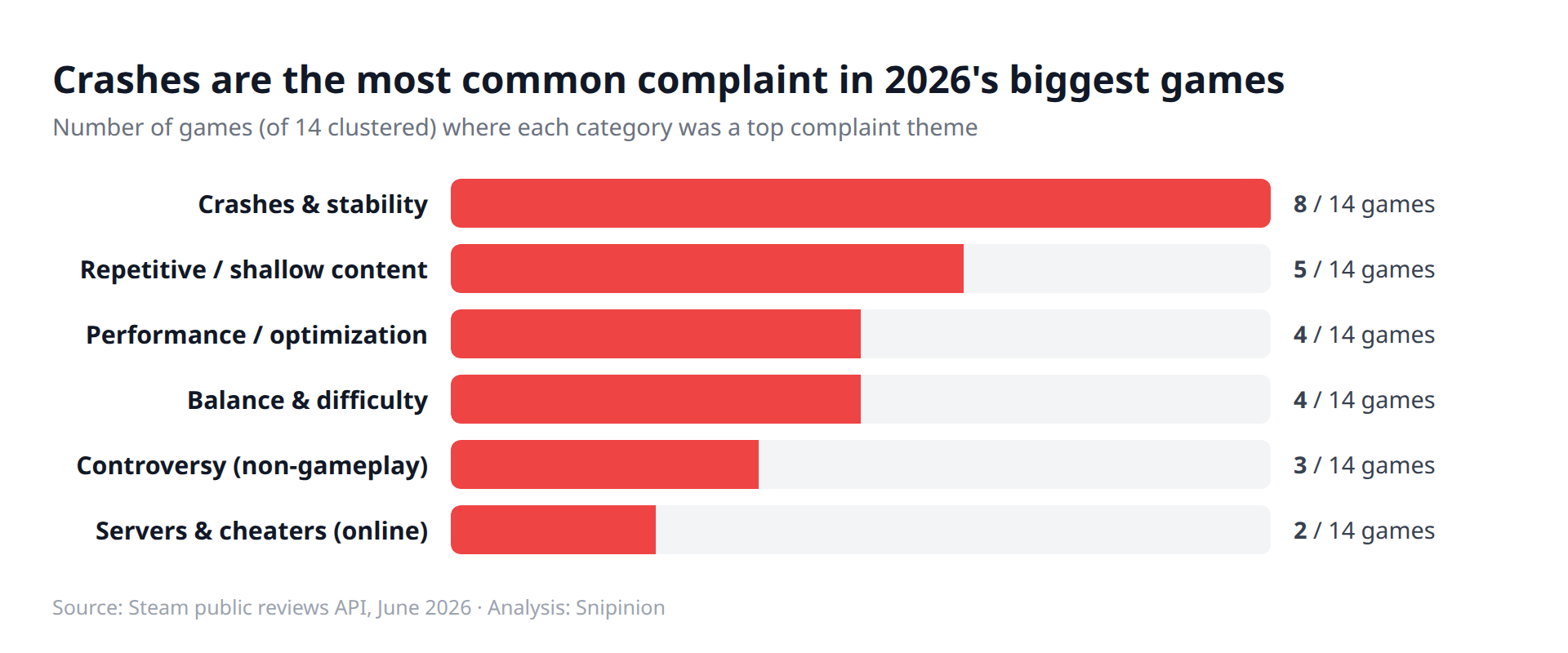
Across the basket, the single most common complaint theme isn't balance, price, or content — it's the game not running properly. Crashes, stuttering, and stability issues showed up as a top complaint cluster in 8 of the 14 games we clustered, including:
- Monster Hunter Wilds — "crashes & lost progress" was 56% of its negative reviews
- inZOI — "performance / crashing" at 46%
- Forza Horizon 6 — "frequent crashes" at 40%
- ARC Raiders — "crashing / can't launch" at 29%
- PRAGMATA — "crashing (Denuvo-related)" at 24%, even on a 97%-positive game
If you ship software in 2026, the lesson is blunt: performance is a feature, and it's the one players punish hardest.
The five complaint patterns that repeat everywhere
After crashes, the same handful of themes recur across genres:
- Repetitive / shallow content — runs out of things to do (PRAGMATA 76%, Forza 60%, Quarantine Zone 40%)
- Performance & optimization — frame drops, bad PC ports (Borderlands 4, inZOI, Gothic Remake, Samson)
- Balance & difficulty — too grindy, too punishing, or tuned wrong (Silksong, Monster Hunter Wilds, Subnautica 2)
- Controversy (non-gameplay) — negatives driven by a decision, not the game itself (Slay the Spire 2, inZOI, Subnautica 2 — more below)
- Online: servers & cheaters — the defining complaint for multiplayer titles (Sea of Thieves 86%, ARC Raiders cheating 31%)
The surprising part: "Very Positive" games still have real complaints
The most useful insight for any product team is that a great rating hides a list of fixable problems. Even the highest-rated games in our basket had clear, recurring complaint themes:
- Resident Evil Requiem (97% positive) — 62% of negatives clustered around confusing / unclear gameplay
- PRAGMATA (97% positive) — 76% of negatives were repetitive gameplay (the hacking loop)
- Hollow Knight: Silksong (93% positive) — 62% on pacing / "forced" progression (a further 38% on difficulty)
None of these games are "bad." But each negative cluster is a concrete, prioritized to-do list — the kind of signal that's invisible if you only watch the star rating.
When a "negative review" isn't about the game
Here's the finding we didn't expect. On several games, a large share of negative reviews weren't about bugs, balance, or content at all — they clustered around a decision or controversy rather than gameplay:
- Slay the Spire 2 (92% positive) — a 38% cluster centered on a development controversy, not the game (its biggest complaint, 62%, was card balance)
- inZOI (79% positive) — its largest negative cluster (55%) centered on its AI features and comparisons to The Sims
- Subnautica 2 (93% positive) — a 52% cluster centered on terms / conditions, not gameplay
This matters because a decision-driven backlash distorts the rating but says little about product quality. Clustering separates "this game crashes" from "I'm reacting to a decision" — so teams can act on the first and contextualize the second. A raw rating can't tell those apart. Theme clustering can.
Top complaint per game (the quick map)
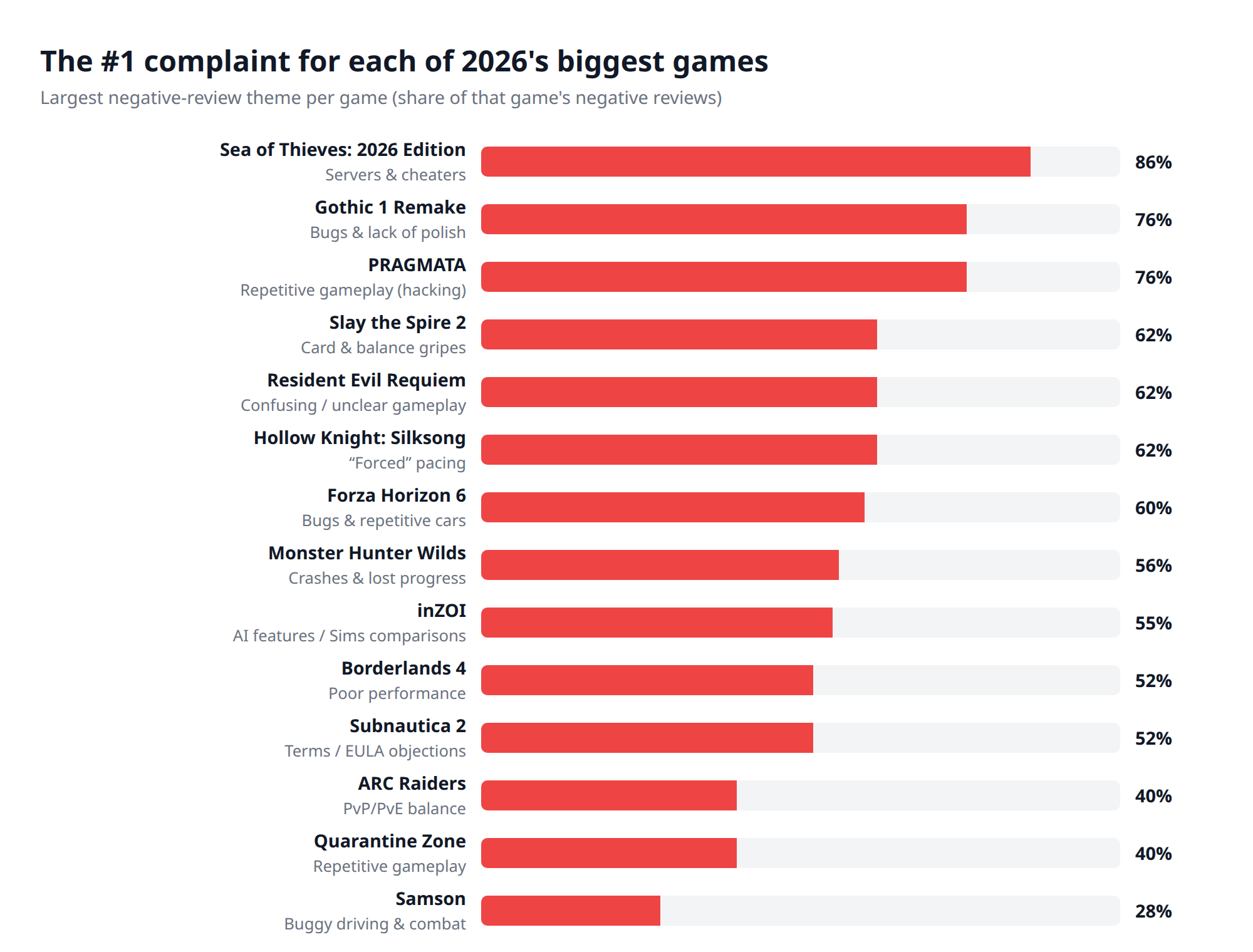
| Game | Steam rating | Biggest negative theme |
|---|---|---|
| Monster Hunter Wilds | Mixed (68%) | Crashes & lost progress (56%) |
| Borderlands 4 | Mixed (61%) | Poor performance (52%) |
| Samson | Mixed (56%) | Buggy driving/combat (28%) |
| ARC Raiders | Very Positive (83%) | PvP/PvE balance (40%) |
| Quarantine Zone | Very Positive (82%) | Repetitive gameplay (40%) |
| Sea of Thieves 2026 | Very Positive (89%) | Servers & cheaters (86%) |
| Forza Horizon 6 | Very Positive (86%) | Bugs & repetitive cars (60%) |
| Subnautica 2 | Very Positive (93%) | Terms / conditions objections (52%) |
| Slay the Spire 2 | Very Positive (92%) | Card & balance gripes (62%) |
| Gothic 1 Remake | Very Positive (85%) | Bugs & lack of polish (76%) |
| Hollow Knight: Silksong | Very Positive (93%) | "Forced" pacing (62%) |
| inZOI | Mostly Positive (79%) | AI features / Sims comparisons (55%) |
| Resident Evil Requiem | Overwhelmingly Positive (97%) | Confusing / unclear gameplay (62%) |
| PRAGMATA | Overwhelmingly Positive (97%) | Repetitive hacking minigame (76%) |
What this means if you ship anything with reviews
Games are just a vivid example. The same pattern holds for e-commerce, SaaS, and apps:
- Your star rating is a lagging, lossy summary. The complaint themes underneath it are the actionable part.
- The biggest issues are often technical (it doesn't work) before they're about features or price.
- Your best reviews still contain your roadmap — the 5-star crowd will still tell you what to fix next.
- Volume hides signal. Nobody reads 50,000 reviews by hand. Clustering turns them into a ranked, evidence-backed list in minutes.
Analyze your own reviews
This whole report was produced by uploading review text to Snipinion and letting it cluster the complaints, rank them by share, and surface example quotes. You can do the same with your product's reviews, support tickets, or app-store feedback.
👉 Try Snipinion free — no signup required and see your top complaint themes in minutes.
Data: Steam public reviews API, June 2026. Analysis: Snipinion. Percentages are shares of clustered negative reviews per game.